Showing posts with label gardening. Show all posts

Thursday, 7 February 2013

Kookaburras in the garden

Love the kookaburras and their raucous laughter which is their distinctive birdsong. Just wish they didn't have to all start laughing when I appear in my recently acquired fitness gear. Perhaps it's because it has a certain 80's, "Jane Fonda" style to it!


Definitely not good for the confidence when even birds are laughing!

- Posted using BlogPress from my iPad

Wednesday, 23 January 2013

Saved fridge dump fees

I have started my new garden beds. Using two fridges that had 'died' as garden beds has saved me dumping fees. Not to mention the hassle of getting them to the dump.
The motor end has had a piece of steel pot riveted over the opening.


The freezer compartment in this one will be great to isolate something that usually takes over.


As you can see it makes a good depth of soil and will keep the ground moist and cool. I have emptied the current compost container into it, along with rotted manure.
Old styrofoam lids can be cut to size to block the ends with a few bricks to hold them up and the soil inside can be filled against this barrier.
This will be left empty till autumn plantings.
I have also begun extending my upside down roof garden too. As you can see the soil depth is not great but shallow rooted plants have done exceptionally well.


This will be filled with compost and well rotted manure as well.
I plan to utilise another roof garden as a strawberry bed next year.
Gardening at waist height is also a great advantage, especially when hunting strawberries.

- Posted using BlogPress from my iPad

Tuesday, 22 January 2013

Garden stress planning day

Everywhere is so dry now and plants are dying in the garden. Rather than just getting more and more depressed I have decided to develop my garden plan for next summer so that I don't repeat mistakes.
You know it's bad when agapanthus struggle to survive!


My biggest issue apart from 45 degree days is lack of water.
One garden that is unexpectedly thriving is the asparagus garden.
Asparagus needs very deep, rich soil and water. The difference here is that I planted the asparagus in an old commercial fridge. Put a couple of holes in the bottom for drainage and used it as a compost pile for about 12 months. Mixed in good soil and planted.


The big difference in using the old fridge is that it is insulated so that helps keep the soil moist and cool. When I do water, very little water is lost to evaporation or draining away uselessly. This is going to be the blueprint for next summer.
I grew my tomatoes in raised beds this year but no matter how much I mulched I still struggled to water efficiently. The other problem is, as I have previously mentioned, the water quality now is terrible and the plants are
starting to die back. My thyme was doing beautifully and has been watered and mulched but it just can't tolerate the water.


My horseradish is also showing signs of stress. I am going to switch to watering this with rainwater now.


My vegetable garden next year will all be in old fridges and baths.

I will continue to use my 'roof' bed as this was so successful for shallow rooted plants like Beetroot, rocket and spring onions.


We have ample rain in winter so I will position a tank next to this bath and fridge garden. I will need to elevate it so that I can use gravity water these gardens with good water. I am also going to look at putting one garden under shade cloth.
This is the plan anyway! I feel better already!


- Posted using BlogPress from my iPad

Saturday, 19 January 2013

Growing Beetroot


This has to be one of the easiest and most forgiving summer vegetables to grow. We have limited water that becomes salty as summer progresses. We have had extreme heat but still my Beetroot soldiers on!
I have grown it in what was previously a curved roof. The soil is about 30cm in the middle to about 15cm at the edge. We put a few holes in it for drainage.


The Beetroot was planted from seed and mulched well with mushroom compost once the leaves were through. The soil was a good mix of well rotted sheep manure and compost. I am overwhelmed with success!


Now I am deciding what to do with my bounty.
I will definitely be making Beetroot rosti.
The great thing about rosti is that they freeze so well and will still come back crisp and beautiful.
I will use my own horseradish (which I have grown for the first time and am about to harvest ) to make horseradish cream to go with it.
Pickled Beetroot will also be a good option.
- Posted using BlogPress from my iPad

Growing garlic


Garlic is easy to grow but does require patience. Plant in autumn and harvest in summer.
A Plot about 1 m square can take about 50 corms but I prefer to plant mine in lots of small plantings throughout the garden.
Garlic is a great companion plant and is supposed to be particularly beneficial when planted with roses and raspberries.
Garlic needs a sunny, open, well drained position.
Good friable soil with plenty of well rotted organic matter. Too much fresh manure will encourage leaf growth and not bulb growth. If your position is not well drained the bulb will rot.
The roots and foliage develop in autumn and winter and the bulb in summer. In late summer the foliage will start to dry off, once the bulb has developed. My friend whose crop I harvested has wonderful soil built up over years and access to lots of clean water throughout summer. Sadly my soil is still being built up and come summer, water is a problem. I use river water and by mid summer the water quality is poor. ( salty)


Easy to see which is mine!
Water regularly and fertilize during the growth stages. Don't water once foliage has dried off.
Planting is easy if you have access to fresh, preferably organic garlic. Don't waste your time and effort trying to grow imported garlic it may have been treated with growth inhibitors. If the garlic is bright white and has a long shelf life it has quite possibly been treated.
To plant, just break the bulbs (corms) away from the parent plant. The parent is the stem in the middle.


Gently push the corm into the soil ( just below ground level) and with the tip pointed upwards. Allow about 10cm between corms.
Mulch and now, be patient, your own crop will be well worth the wait!
- Posted using BlogPress from my iPad

Wednesday, 26 December 2012

Kangaroos in the garden

Went to put the rubbish out. Not sure who got the bigger surprise!


What a magic way to begin the day. When he stood up he was taller than me. I backed off and he was happy to stay.
About an hour later he ambled off!


- Posted using BlogPress from my iPad

Tuesday, 11 December 2012

Zucchini Madness

Freezing raw, grated zucchini. Is this something else that everyone knew except me?


When I am overwhelmed with zucchinis I freeze them. It's so easy.
Just grate them and pack them into freezer bags in the amounts to suit recipes for zucchini slices and cakes. Great in winter, handy for soups too!
- Posted using BlogPress from my iPad

Sunday, 25 November 2012

Growing and storing garlic


I love garlic and use lots in cooking. It is also an excellent plant as a companion plant for many other plants. The idea behind companion planting is that some plants can give off a smell or perfume that can deter pests or is attractive to natural predators. For instance planting onions with cabbages helps control cabbage moth. Garlic is credited with keeping aphids away from roses. I grow garlic with roses and so far have not had aphid attacks.
Garlic is also good to grow under fruit trees. It also excellent for making natural garden pest sprays.
A family friend who has the most amazing garlic crops, doesn't use garlic. She gives it to me. So this is what do, as I hate to waste it.


This is a photo of the top of a garlic plant when it forms the seed head and once it dries off it is time to harvest. I have pulled this one up to show even though it has not dried off. The tiny yellow pods you can see on the side of the bulb can be planted.


I clean the garlic by first removing the roots and as much dirt as I can, peeling off the outside layer of skin and then wiping it off under running water. Don't get it too wet. Allow it to dry completely on kitchen paper( usually overnight) If it is left wet it will go mouldy. Lots of bought garlic is treated to prevent this. If you are buying garlic and it is bright white and has a very distant use by date it would be worth asking if it has been bleached and treated with chemicals.


I keep my garlic in a bowl so that is always in the air not sealed up in plastic.
I hate washing garlic presses processing it reduces that problem. I break the garlic into cloves and peel off the dry outer skin. Make sure the bulbs are scrupulously clean if in doubt rinse them again, dry them off with some paper towel. Put them in a mini food processor and just cover with oil. I use the light vegetable oil that I would normally use for stir fries etc.


Process it till it is finely chopped. Sterilise a small clean jar that has a tight fitting lid. I do this by putting a little water in the jar, and of course minus the lid, I put the jar in the microwave on high for one minute. The jar will be very hot so be careful. Using you oven glove remove the jar, tip out the water. Don't dry it with a teatowel as it is now sterile. Put your processed garlic in the jar. Put a film of oil over the top and screw lid on tightly and store in fridge.


Always use a clean spoon to take garlic out, provided you keep your jar in the fridge this will keep for about four weeks.I keep doing small batches as I run out. The dry, clean garlic will keep for several months. Then, when making a stir fry or any other dish you are cooking just add the ready prepared garlic. This is not suitable for pestos as I prefer fresh garlic for all uncooked recipes.
Great time saver!
P.s. You can also do this with ginger but I have several ways to store ginger so that will be new post.
- Posted using BlogPress from my iPad

Wednesday, 21 November 2012

Australian native birds beneficial in the garden

I love to encourage the native birds to come into the garden. Not only are they a joy to watch but they also control many predatory bugs in the garden.
From the tiny blue wrens


To the very busy Honeyeaters


To the lovely noisy parrots.


They all play their part in keeping the bugs under control and are welcome. But I do draw the line at their idea of sharing the fruit that I grow. So I net my trees and berry bushes


- Posted using BlogPress from my iPad

Tuesday, 20 November 2012

Pests attacking basil seedlings

I think that the sap sucking,leaf eating bugs had sentries in the garden to alert them when I planted lush little basil seedlings. I would come out in the morning and find all that was left of my beautiful seedling was a mutilated stalk. I gave up trying to plant them in the open garden because they were obviously so irresistible to slugs, snails and others.
So I tried to get sneaky and put a barrier between them and my plants.
I planted them in pots, but as a further barrier I put them up on a wire netting frame about two feet off the ground.
And so far, so good, the plants are surviving nicely.
Soon I will be making basil pesto using the same recipe as I make for rocket pesto.


In the background is my asparagus bed but more about that later!

- Posted using BlogPress from my iPad

Blackbirds making a mess of garden beds and paths. A solution!

I love birds in the garden but the blackbirds make a huge mess of my paths and garden borders. As fast as I mulch my garden beds and my pot plants they spread the mulch everywhere over paths and verandas in their search for worms. This really defeats the whole purpose of mulching as well as making a huge mess.
I have finally defeated them!
As I have said before I keep things in case they will be useful in the future. I had kept some cheap plastic gutter guard that had never really worked. So what I did was stretch this along the garden edge and peg it down with some small tent pegs ( but wire looped over would also work).


I lightly covered the mesh with some mulch so that you could not see it but not enough to make the blackbird interested.


Days later the path is still clear!


And for pot plants I found that I had kept some small offcuts of the fine wire used for repairing screen doors. So I just cut that to the size of the pot and put it over the mulching in the pot and I am a winner here too!


Posted using BlogPress from my iPad

Growing Rocket

Rocket has to be the easiest thing to grow. Snails and slugs are not really keen on it unlike soft lettuce varieties.
The rocket plants in the picture below have gone to seed and I will let them dry off.


Once these are dry I either do one of two things. I throw them on the garden where I would be happy for them to grow.


Or alternatively I hang the plants, seed heads down, in an old pillowcase to collect the seeds. Then I keep them in a clean airtight jar for planting.
Like Chard I have pockets of rocket all over the garden. And I start new plantings every few weeks to ensure a continuous supply.

Not sure if it is called rocket because it grows at rocket speed!


The flowers are pretty and edible and look great in a salad!


Posted using BlogPress from my iPad

Tuesday, 13 November 2012

Strawberry Disaster

I watch lots of garden shows and read lots of gardening magazines for tips and ideas. This one sounded good in principle but has not worked at all. This has been one of my failures. The idea was to line a pallet with hessian or something similar and fill it with compost. Next step is to make pockets and plant the strawberries in the pockets.


I thought it sounded great in theory and would solve the millipede problem and be easy to net. Wrong! Well it would be easy to net and I don't have millipedes because I don't have much fruit either. When we first put it up we had it too upright. So whilst the top plants got water the rest missed out. Then I put it on more of an angle then the top doesn't hold much water and the rest still didn't get much water. It hasn't worked. 


If I had used my brains I would have realised that unless you put drip lines inside the pallet water was never going to get there. And it would waste water so I will be dismantling this and planting the strawberries in containers. 


Ah well, we live and learn!


I do however have lots of strawberries growing in other parts of my garden but they are not netted and I think they are the birds share of my garden bounty! However the biggest problem is Spanish millipedes.


These loathsome creatures were accidentally introduced to Australia about 20 or 30 years ago and have devastated many crops. As soon as the strawberries show any colour they invade. They hollow the strawberry out so there is just a paper thin shell left. 

They have no natural predators here, the birds won't touch them and they live in soil and mulch as they love damp places. So I have planted my strawberries in containers so that they are off the ground (easier for picking too) and I can net them. These are in the upside down lid of an old barbecue. And it is working well!


Sometimes things work and sometimes they don't but gardening is always a learning process!


Monday, 12 November 2012

My Australian Kitchen Garden


"If you look the right way, you can see that the whole world is a garden." - F. H. Burnett

My Kitchen Garden


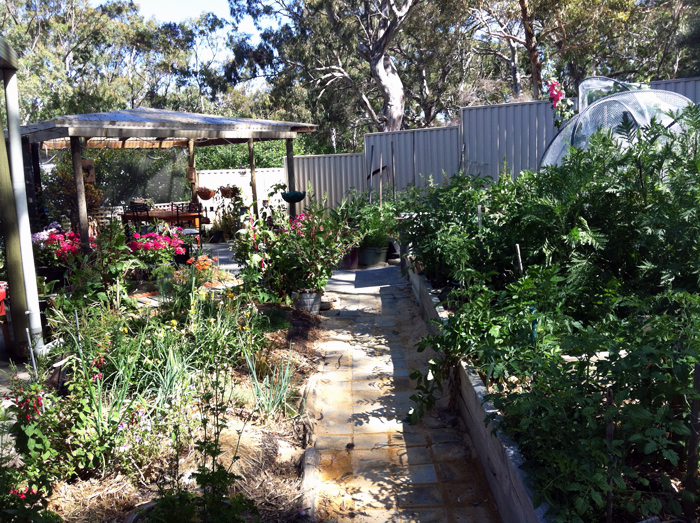
Vegetables and flowers all in together. Nature doesn't do straight lines and dedicated garden beds so neither do I!


Growing Potatoes in Bags

There is nothing that tastes nicer than baby potatoes freshly dug, cooked in their skins and then lightly tossed in olive oil or butter and chopped fresh herbs like parsley and chives or mint.

I have been successful growing potatoes before on other properties but here we have two problems . One is that the garden wildlife digs them up and eats them no matter what I do. The second problem is we have to rely on river water for irrigation and since we share the water with fish, yabbies and other wildlife once the river gets low in summer there is no more water except for our rainwater tanks.

So this year I decided to try something different. I had bought a number of bare rooted trees that came in strong plastic bags so I decided to put these to good use as potato growing bags. I also had some horse feed bags that I could use. ( I have since seen gardening shops advertising purpose use bags to do this but these are free and I hate waste and like reusing things!).

Potatoes in horse feed bags


Whilst one of the problems I had was not wanting to waste water, I also had the problem of needing good drainage, since potatoes will rot if they get too wet. I already use mushroom compost for mulch in the garden so I decided to line the bag with mushroom compost so that would hold the moisture. I then put in a layer of dirt about 15 cm deep with some well rotted organic fertilizer mixed in. Then I cut up my potatoes that had already begun to sprout. I cut them into about three pieces making sure each piece had sprouted. I put the three pieces in the bag and then just covered them lightly with soil.


Growing Potatoes in Bags

As soon as the new leaves showed I kept building up compost, soil or straw around the shoots with the leaves until the bag was full. I watered sparingly as I didn't want it to get soggy. As you can see my plants are now well over the top of the bag and are hopefully setting potatoes under the ground. I now have to wait for flowers to appear on the plants and then the tops will die and I can pick the potatoes. 


It is really important that I don't overwater at this stage as the potatoes will rot. Lots of books say you can't use potatoes to grow that you have bought for eating. I have read that some potatoes are treated so that they won't sprout but as I only buy organic unsprayed potatoes to eat I can't see the problem. When I visit my daughter I raid her vegetable bin for any forgotten organic potatoes that have begun to sprout. My plants do look lovely and healthy but I will just have to wait and see if this has been successful. I will let you know how it goes!


Sprouting


Have a lovely gardening day!

Y x